


Elysäische Trümmer. W.G. Sebalds Manchester und die Poetik des Verfalls
Sažetak
This essay explores W. G. Sebald’s literary representation of Manchester as a topography of memory and as a site of poetic reflection on decay, exile, and remembrance. Drawing on Sebald’s years in Manchester (1966–1968, 1969/70) and the relevant archival material extant in the Deutsches Literaturarchiv Marbach, the article traces Sebald’s engagement with Elias Canetti, Ernst Bloch, and Walter Benjamin. Through a close reading of the Manchester passages in The Emigrants, it demonstrates how Sebald transforms industrial ruins into vessels of collective memory, poetically reimagining the city as “fallow Elysian Fields.” Combining literary topography, intertextuality, and poetics, the essay interprets Sebald’s Manchester as a liminal space in which document and fiction, past and present, hope and destruction converge into a single, haunting continuum.
Preuzimanja
Stranice
15-36
Objavljeno
03.09.2026.
Autorska prava (c) 2026 Goran Lovrić; Brigita Kacjan, Ana Filipović, Goran Lovrić, Johann Holzner, Marijana Jeleč, Luna Kunecki, Saša Jazbec, Sarah Löwenkamp, Marija Mojca Peternel, Marija Perić Šormaz, Nikolina Miletić; Anita Pavić Pintarić, Marijana Jeleč; Paul Whitehead, Natalia Fuhry, Mario Huber, Petr Pytlík, Gábor Kerekes, Monika Wolting, Andreja Retelj
Kako citirati
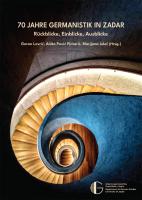
Whitehead, P. (2026). Elysäische Trümmer. W.G. Sebalds Manchester und die Poetik des Verfalls. U G. Lovrić, A. Pavić Pintarić, & M. Jeleč (Ur.), 70 Jahre Germanistik in Zadar: Rückblicke, Einblicke, Ausblicke (str. 15-36). Morepress Books. https://doi.org/10.15291/9789533316505.01


